A week ago I met with an aspiring entrepreneur who had some interesting ideas regarding a recruitement startup. But during the conversation I got the feeling that he was holding his cards close and I was having a little trouble getting the whole picture. Towards the end of the conversation he confided that he was really vested in his ideas for the startup and that it actually hurt to hear those ideas criticized.
This got me thinking. I was also once this way - I held my "good ideas" close so they wouldn't be stolen away. And when people poked at the faults in my ideas... well, it hurt. But over the years I came to realize that this way of thinking is flawed.
I was lucky enough last week to find myself drinking a beer with Pat Poels, Eventbrite VP of engineering and two-time World Series of Poker bracelet winner. And I was luckier still that he was in the mood to talk about his poker days. I love hearing these stories but I'm always reluctant to ask because I suspect people ask him about "the poker days" all the time.
In the start of the discussion Pat was talking about just how much of an edge you have if you are able to read people closely. He told me a story about a very subtle tell that one of his old poker buddies fell victim to. This friend, we'll call him Bob, had the tendency to fold his hand quite predictably when confronted with the right circumstances. In particular, if Bob knew that he had a bad hand and if someone else showed an inclination to start betting aggressively, then Bob would quickly leave the hand on the table. Another one of Pat's buddies noticed this first. This buddy, (we'll say Steve), found out that every time he wanted to check on Bob's hand, all he had to do was riffle around his chips, indicating that he was in the mood to bet big. If Bob folded, then that would be the answer Steve was looking for. If Bob didn't fold then Steve would think long and hard about whether or not his hand was good enough to stay in the game. Thus, having this one insight into Bob's behavior and psychology provided quite an edge to Steve's game.
Following Pats story I aimed the conversation more towards business. "In the time since you retired from poker have you put your psychic ability to read people to any business use?" In my mind I pictured Pat in board meetings peering into colleagues eyes and inferring any hint of a hidden agenda.
"It's not a psychic ability." This is where Pat turned my thoughts around on me. "And the important lessons that I learned from poker were not about reading others but about reading myself." Then he explained: Even though reading others' tells could give you an advantage in poker and in life, that advantage pales in comparison to being able to understand your own intentions and motivations, your own abilities, and the limitations of what you can know about the world around you.
Influence Marketing is a form of marketing in which focus is placed on specific key individuals rather than the target market as a whole. It identifies the individuals that have influence over potential buyers, and orients marketing activities around these influencers. (Yep, totes stole that from Wikipedia.)
If you've been friends with me for very long, you've probably heard me reference my mysterious side-project, the social-network-infiltrator! Basically it is a Twitter graph scraper that is able to apply simple algorithms and answer interesting questions. Questions like:
As a developer, my understanding and respect for software testing has been slow coming because in my previous work I have been an engineer and a consultant, and in these roles it wasn't yet obvious how important testing really is. But over the past year I have finally gained an appropriate respect and appreciation for testing; and it's even improving the way I write code. In this post I will explain where I've come from and how far I've traveled in my testing practices. I'll then list out some of the more important principles I've picked up along the way.
In his 1943 paper, A Theory of Human Motivation, Abraham Maslow introduced a simple principle that has had a profound influence in the fields of psychology and sociology. Namely, he introduce the concept of a hierarchy of human needs which he termed Physiological, Safety, Belongingness and Love, Esteem, Self-Actualization and Self-Transcendence. And Maslow's big main point here was that it is necessary to first satisfy the basic needs before we can even have the luxury to start worrying about the higher-level concerns. But for me, looking through Maslow's hierarchy in some detail, it seems that all the cool kids hang out towards the top of that hierarchy. I've been there in the past, and am occasionally so fortunate as to touch the top of the hierarchy again from time to time. But I think that I (we) can do better than this! So I determined myself to try and devise a way to "hack" Maslow's Hierarchy so as to maximize the time I'm spending near the top.
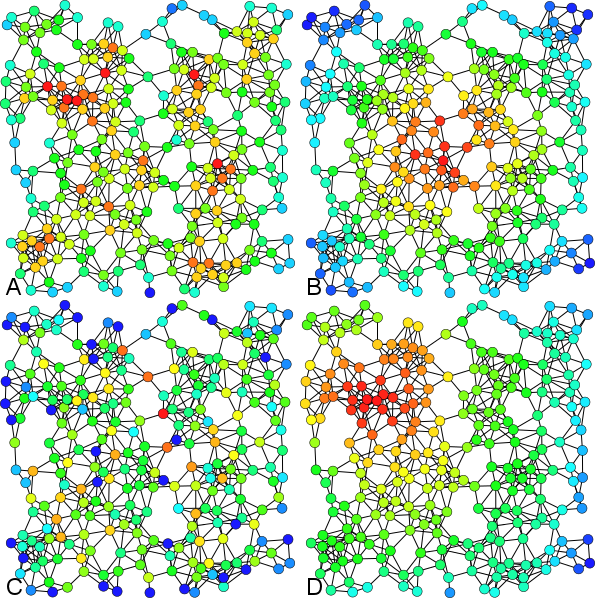
If you play around much with graphs, one of the first things that you'll run into is the idea of network centrality. Centrality is a value associated with a node which represents how important and how central that node is to the network as a whole. There are actually quite a few way of defining network centrality - here are just a few:
Examples of A) Degree centrality, B) Closeness centrality, C) Betweenness centrality, D) Eigenvector centrality. -- Figure shamelessly stolen from Wikipedia
Degree centrality - This, the simplest measure of centrality, is simply the count of how many a connections a particular node has.
Closeness centrality - This is the inverse of a node's farness. Farness, in turn, is the sum of the length of the shortest paths connecting the node in question to all other nodes.
Betweenness centrality - This is the count of number of shortest paths that pass through a given node.
But, my favorite measure of centrality is eigenvector centrality. Why? Because I invented it! Ok, ok... that's not exactly true, but I did at least independently discover it. And the way I discovered it helped it stick in my mind ever since.
This is the first post of what I hope will be many posts to come. Being the first, I feel that it is import to lay out the themes that I intend to cover and the goals that I expect to achieve. However -- having not the slightest idea of what I will do with this blog, or even if I'll do anything with it at all, you'll have to be satisfied with the pretentious sounding introductory material which you are currently reading.